
They Hated the Yoruba Before Tinubu. Tinubu Just Made It National.
The Igbo did not start hating the Yoruba in 2023. They started long before that — quietly, in WhatsApp groups, in X threads, in the sneering dismissal of adire, of ewedu, of Yoruba music, of Yoruba cities. Tinubu's election just gave them permission to say it out loud. Ishola Adebiyi is not interested in being polite about it.
.jpg)
Ishola Adebiyi
Lead Correspondent, The Trojan Beast
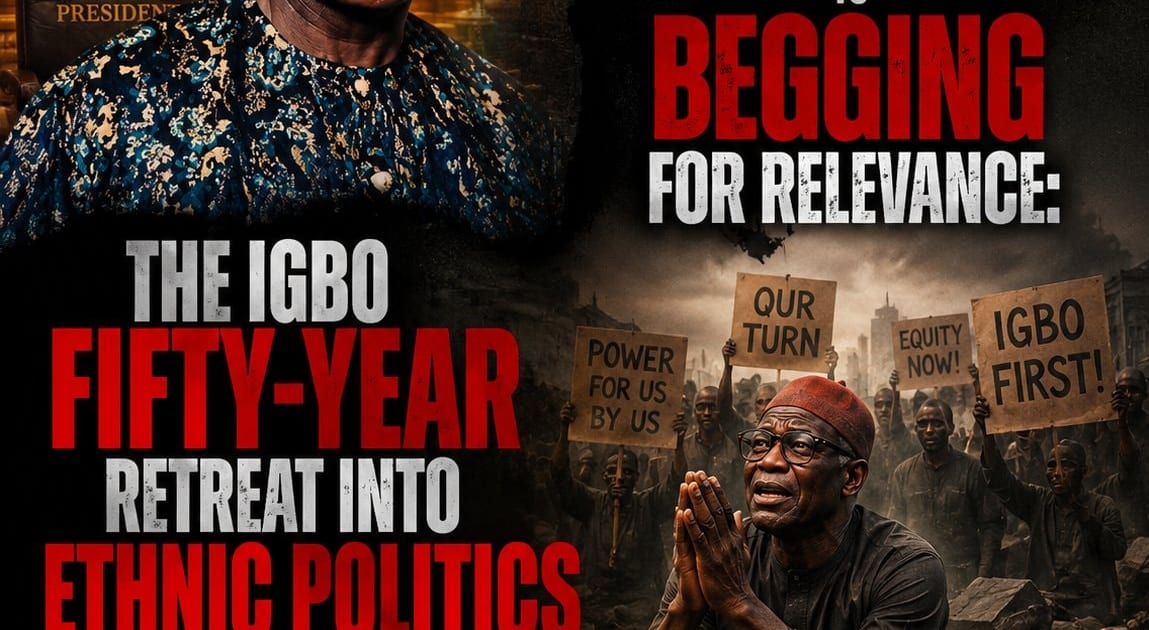
Let us start with the adire.
When Nigeria's First Lady, Senator Oluremi Tinubu, wore adire to a public function — a fabric that has been produced in Yorubaland for centuries, that has been exhibited in museums from London to New York, that has dressed royalty and commoners alike across generations — a section of Nigerian social media erupted in mockery. Not gentle teasing. Not political satire. Mockery. The kind that is designed to diminish, to belittle, to say: your culture is beneath us.
The accounts leading the charge were not hard to identify. The same handles. The same flags in the bio. The same people who had spent the previous two years telling you that Tinubu stole the election, that Yorubas are sellouts, that Lagos belongs to everyone except the people who built it.
They were not mocking a politician. They were mocking a fabric. They were mocking a tradition. They were mocking a people. And they did it with the confidence of a group that has convinced itself that its contempt for Yoruba culture is not bigotry — it is sophistication.
It is not sophistication. It is envy wearing a mask.
The Hate Predates Tinubu by Decades
Here is the thing that the "Tinubu caused division" crowd does not want you to understand: the Igbo did not start hating the Yoruba in May 2023. The resentment is older than that. It runs deeper than that. Tinubu's election did not create the hostility — it simply gave people who had been nursing it in private the permission to express it in public.
Go back to 2019. Go back to 2015. Go back further. The contempt for Yoruba culture, Yoruba food, Yoruba language, and Yoruba cities has been a consistent undercurrent in certain online spaces for years. Ewedu jokes. Mockery of Yoruba names. Dismissal of Yoruba music as "noise." The suggestion, repeated endlessly, that Lagos is only great because of Igbo commerce — as if the city's infrastructure, its institutions, its governance, its cultural output, and its identity were all built by people who arrived from somewhere else.
The Obidient movement did not invent this contempt. It organised it. It gave it a political vehicle, a hashtag, and a moral framework. Suddenly, hating the Yoruba was not bigotry — it was resistance. Mocking Yoruba culture was not tribalism — it was speaking truth to power. And when Tinubu won, the mask came off entirely.
"They were not mocking a politician. They were mocking a fabric. They were mocking a tradition. They were mocking a people. And they did it with the confidence of a group that has convinced itself its contempt for Yoruba culture is sophistication. It is not. It is envy wearing a mask."
— Ishola Adebiyi, The Trojan Beast
What the Yoruba Actually Built
Let us talk about what the Yoruba built, since the people mocking adire seem to have forgotten.
Ibadan is the largest city in sub-Saharan Africa by land area. It was a major urban centre before the British arrived, before the colonial project reorganised West Africa, before anyone was drawing maps of Nigeria. The University of Ibadan — Nigeria's first university — sits there. The Cocoa House, built in 1965 with proceeds from Yoruba farmers' cocoa exports, was the tallest building in sub-Saharan Africa at the time of its construction. Built with Yoruba money. Built with Yoruba vision. Built without asking anyone's permission.
Abeokuta. Ile-Ife — the cradle of Yoruba civilisation, a city whose oral history, bronze casting, and religious traditions predate the arrival of Islam and Christianity in West Africa. Osogbo, home of the Sacred Grove, a UNESCO World Heritage Site. Benin City — yes, the Benin Kingdom, whose bronzes are in the British Museum and whose walls were described by European explorers as more impressive than anything they had seen in Europe at the time.
Lagos. A city that was a fishing settlement and became the commercial capital of the most populous Black nation on earth. Not because of geography alone. Not because of oil. Because of governance, because of infrastructure investment, because of a political class — whatever its faults — that understood that a city must be built, maintained, and managed. The same city that the "Lagos belongs to everyone" crowd wants to claim credit for while dismissing the people who actually run it.
Yoruba music gave the world Afrobeats. Not as a solo act — but the foundation, the structure, the harmonic language that Fela Kuti built and that Burna Boy, Wizkid, and Davido are now selling out stadiums with, was laid in Yorubaland. Jùjú music. Fuji. Apala. Traditions so rich, so layered, so technically sophisticated that ethnomusicologists have spent careers studying them.
And then there is adire. Hand-dyed, resist-patterned, indigo-soaked fabric that has been produced in Abeokuta and Ibadan for generations. A textile tradition that predates the Nigerian state by centuries. A fabric that is now sold in boutiques in Paris and New York to people who understand craft and beauty. A fabric that a First Lady wore with pride — and that a group of people with nothing comparable to show decided to mock.
The Language They Cannot Stop Mocking
Yoruba is one of the most widely spoken languages in Africa. It is spoken by over 50 million people across Nigeria, Benin, Togo, and the diaspora. It has a tonal system of extraordinary complexity. It has a literary tradition — oral and written — that stretches back centuries. It has produced Nobel laureate Wole Soyinka, whose command of the English language is so complete that he uses it as a weapon, but whose roots in Yoruba oral tradition are visible in every line he has ever written.
The Yoruba language has loanwords in Brazilian Portuguese, in Cuban Spanish, in Haitian Creole — because the enslaved Yoruba who were taken to the Americas carried their language with them, and it survived. It survived the Middle Passage. It survived plantation slavery. It survived centuries of deliberate cultural erasure. And it is still here.
The people mocking Yoruba names on X Spaces are mocking a language that outlasted the slave trade. Think about that for a moment.
The Food They Cannot Stop Sneering At
Ewedu. Gbegiri. Amala. Eba. Egusi. Banga. The Yoruba food tradition is one of the most varied, most technically demanding, and most nutritionally sophisticated in West Africa. Ewedu soup — the one that became a punchline in certain circles — is a jute leaf preparation that requires skill, timing, and knowledge passed down through generations. It is eaten by millions of people across Yorubaland and beyond. It is not a joke. It is a meal.
The people sneering at Yoruba food are, in many cases, from a region whose most famous export to the rest of Nigeria is ofe onugbu — a bitter leaf soup that is, by any objective measure, an acquired taste. We are not here to mock it. Every food tradition has dignity. Every cuisine reflects the land, the history, and the ingenuity of the people who developed it. The difference is that Yoruba people are not on X making videos mocking Igbo food. The traffic runs in one direction.
"The people mocking Yoruba names on X Spaces are mocking a language that outlasted the slave trade. Think about that for a moment."
— Ishola Adebiyi, The Trojan Beast
Why the Hate Became National After Tinubu
When Bola Tinubu won the 2023 presidential election, something broke in a section of the Igbo political psyche. Not because Tinubu was an illegitimate candidate — he won a contested election, certified by a court, in a process that the same people who reject the result had previously described as the most credible in Nigerian history when their candidate was ahead in the polls. But because a Yoruba man won.
The logic, stated plainly, was this: the Igbo had waited long enough. It was their turn. And the Yoruba — who had already "had their turn" with Obasanjo — had no right to produce another president before the Igbo produced their first. The fact that Obasanjo was Yoruba but ran as a PDP candidate with Northern backing, not as a Yoruba project, was irrelevant. The fact that Tinubu built a political coalition over twenty years, delivered Lagos, and earned his position through decades of political work was irrelevant. A Yoruba man was in Aso Rock. That was the offence.
And so the hate that had been simmering — the adire mockery, the ewedu jokes, the "Lagos is not Yoruba" revisionism, the contempt for Yoruba music and language — became a political programme. It was dressed up as democracy. It was dressed up as anti-corruption. It was dressed up as "we the people." But underneath all of it was something much simpler and much uglier: we cannot stand that they won.
The Innocent Things They Decided to Hate
Here is what makes this particular strain of hatred so revealing: it did not stop at Tinubu. It did not stop at APC. It did not stop at politicians or policies. It went after the fabric. It went after the food. It went after the language. It went after the cities. It went after ordinary Yoruba people who had never been near a ballot box in their lives.
Yoruba traders in Onitsha reported hostility. Yoruba students in Southeast universities reported harassment. Yoruba professionals in Igbo-dominated industries reported being frozen out. None of these people are Tinubu. None of them made the electoral commission's decisions. None of them are responsible for fuel prices or naira devaluation. They are just Yoruba. And that, apparently, was enough.
This is the definition of ethnic hatred. Not political disagreement. Not policy criticism. Ethnic hatred: the targeting of ordinary people for the actions of leaders they did not choose, on the basis of an identity they were born into.
The Igbo political class, which has spent years demanding that Nigeria recognise and condemn anti-Igbo sentiment wherever it appears, has produced this. And it has produced it in plain sight, with hashtags, with viral videos, with coordinated campaigns — and then had the audacity to hold X Spaces about "Igbophobia."
What Yoruba Superiority Actually Looks Like
We are not going to pretend that "superiority" is the right word for what the Yoruba have. The Yoruba do not need to be superior to anyone. They do not need to win a competition that nobody entered. What the Yoruba have is a record. A long, documented, verifiable record of building, creating, governing, and producing — in conditions that were often hostile, often unfair, and often designed to hold them back.
They built Ibadan when it was a war camp and turned it into a metropolis. They built Lagos when it was a lagoon settlement and turned it into a global city. They produced Soyinka when the world was not ready for an African Nobel laureate. They produced Fela when the government was trying to silence him. They produced Afrobeats when the music industry was not paying attention. They produced a president — not by demanding their turn, but by doing the work.
That is not superiority. That is excellence. And excellence does not need the validation of people who are too busy mocking adire to build anything of their own.
A Final Word to the Mockers
You mocked the adire. The adire is in Paris boutiques. You mocked the ewedu. The ewedu is feeding millions of people who are not on X arguing about it. You mocked the Yoruba language. The Yoruba language survived the slave trade and will survive your X Spaces. You mocked Yoruba cities. Ibadan was a city when your ancestors were still negotiating which market to trade in.
You hated the Yoruba before Tinubu. Tinubu just made it national. And in doing so, you revealed something that no amount of "Igbophobia" vocabulary can cover up: that the contempt was never about politics. It was always about culture. About identity. About the unbearable fact that another group built something magnificent and you cannot stand to admit it.
The Yoruba are not asking for your approval. They never were. They were too busy building.
Don't miss the next story
Get The Trojan Beast's biggest stories delivered to your inbox.
Found this story important? Share it.
More to Read
More Opinion


About the Author
Ishola Adebiyi
Lead Correspondent, The Trojan Beast
Ishola Adebiyi is the lead correspondent and co-founder of The Trojan Beast. He covers Nigerian politics, power, and accountability with a sharp eye for the stories nobody else wants to touch.