
Cardinal Onaiyekan Wants Tinubu to Resign. He Told Jonathan to Dialogue. The Record Does Not Lie.
When Boko Haram was burning the North-East under Goodluck Jonathan, Cardinal John Onaiyekan's prescription was engagement, patience, and dialogue. Now that Bola Tinubu sits in Aso Rock, the same insecurity is suddenly grounds for resignation. Ishola Adebiyi is not letting this one pass.
.jpg)
Ishola Adebiyi
Lead Correspondent, The Trojan Beast
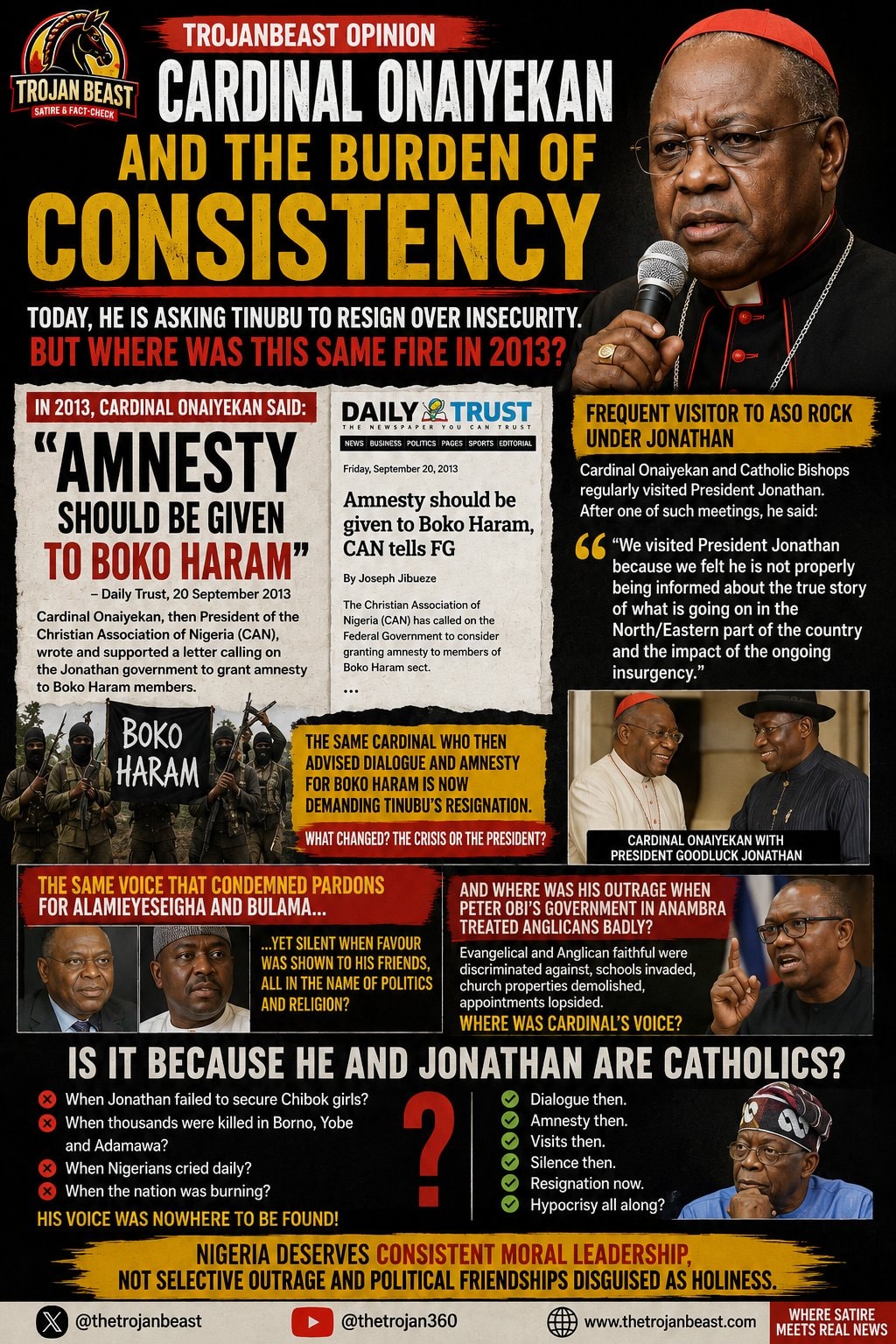
Let us begin with what Cardinal John Onaiyekan actually said — not the version his admirers are circulating, but the full, documented, on-the-record version.
In 2013, when Boko Haram was executing mass kidnappings, bombing churches, slaughtering soldiers, and turning the North-East of Nigeria into a killing field, Cardinal Onaiyekan sat down with President Goodluck Jonathan and came out of that meeting with a message for the nation. The Catholic Bishops, he explained, had visited because they believed the President was not being properly informed about the true situation in the North-East. They wanted to present him with the realities on the ground. They wanted to help. They wanted to engage.
He also publicly supported dialogue. With Boko Haram. With the people planting bombs in markets and abducting schoolgirls. The prescription, in 2013, was: talk to them. Engage. Be patient. The President needs better information. Give him time.
Now it is 2026. Bola Tinubu is in Aso Rock. And Cardinal Onaiyekan's prescription has changed. Dramatically. The answer now is not dialogue. Not engagement. Not patience. Not a pastoral visit to help the President understand the situation better.
The answer now is: resign.
We are entitled to ask what changed. The insecurity? Or the occupant of Aso Rock?
The Advice He Gave Jonathan Was the Advice That Bit Nigeria
Here is the part that the Cardinal's defenders will not discuss. The "engage, dialogue, be patient" approach that Onaiyekan advocated during the Jonathan years was not just ineffective — it was actively harmful. While respected voices like his were counselling patience and dialogue, Boko Haram was consolidating territory, recruiting fighters, acquiring weapons, and building the infrastructure of an insurgency that would eventually require a full military campaign to roll back.
The Chibok girls were abducted in April 2014 — a full year after Onaiyekan was advising engagement and dialogue. Two hundred and seventy-six schoolgirls. Taken in the night. And the government that Onaiyekan had been patiently advising, carefully briefing, and gently encouraging had no answer. No rescue. No plan. Just a First Lady crying on television and a hashtag.
The advice Onaiyekan gave Jonathan did not save the North-East. It gave cover to an administration that was paralysed, corrupt, and fundamentally unserious about the security of its own citizens. The patience he preached bought Boko Haram time. The dialogue he advocated went nowhere. And the President he protected from accountability lost the 2015 election in the most consequential democratic transfer of power in Nigerian history — because Nigerians had seen enough.
Now the same man who counselled patience then is demanding resignation now. The same man whose advice contributed to the environment in which the insurgency metastasised is positioning himself as the moral authority on security governance. The audacity is breathtaking.
"The advice Onaiyekan gave Jonathan did not save the North-East. It gave cover to an administration that was paralysed and fundamentally unserious about the security of its own citizens. The patience he preached bought Boko Haram time. Now he wants Tinubu to resign. The audacity is breathtaking."
— Ishola Adebiyi, The Trojan Beast
Peter Obi's Fingerprints Are All Over This
Let us not be naive about the political context in which this resignation call is landing. Cardinal Onaiyekan is not operating in a vacuum. He is operating in a Nigeria where Peter Obi — the Labour Party candidate who lost the 2023 presidential election and has spent every day since trying to relitigate it — has been systematically cultivating the Catholic Church as a political instrument.
This is not a new playbook. Obi used it in 2023. He positioned himself as the candidate of the faithful — the clean, the righteous, the God-fearing alternative to the corrupt establishment. He packed church auditoriums. He gave interviews to Christian media. He made sure that every major Catholic and Pentecostal platform in the South had his message. And when Bishop David Oyedepo — the founder of Winners Chapel, a man whose congregation numbers in the millions — effectively endorsed the "take back your country" narrative from his pulpit, Obi's campaign treated it as a divine mandate.
"Take back your country." From whom? From Tinubu? From the Yoruba? From Muslims? The phrase was never defined because it did not need to be. The congregation understood. The social media army understood. The Obidient movement understood. And when Tinubu won anyway, the same religious infrastructure that had been mobilised for the campaign became the infrastructure for the resistance.
Cardinal Onaiyekan calling for Tinubu's resignation in 2026 is not a spontaneous pastoral intervention. It is the latest move in a political operation that has been running since March 2023. Obi needs the Catholic hierarchy to keep the pressure on. The Catholic hierarchy — or at least a vocal segment of it — is happy to oblige. And the Nigerian public is supposed to receive this as independent moral leadership.
It is not independent. It is not moral. It is politics in a cassock.
The Oyedepo Precedent and the Church That Wants to Rule
Bishop Oyedepo told his congregation to "take back their country." Cardinal Onaiyekan is telling the nation that the President must resign. These are not pastoral statements. These are political directives issued from pulpits to congregations that are expected to translate them into action.
This is a pattern, and it is a dangerous one. Nigeria is a secular state — not because religion is unimportant, but because the alternative is a theocracy, and theocracies do not end well for anyone, including the religious institutions that helped create them. The moment the church becomes a political party with tax exemptions and moral authority, the moment bishops and cardinals start issuing resignation demands and electoral endorsements from the pulpit, the line between faith and power has been crossed in a way that is very difficult to uncross.
Oyedepo's "take back your country" was aimed at a Yoruba Muslim president. Onaiyekan's resignation call is aimed at the same man. The common thread is not theology. The common thread is Tinubu. And the common thread behind the common thread is Peter Obi, who has spent three years trying to use every available institution — the courts, the media, the church — to achieve through pressure what he could not achieve through votes.
The church should take back its pulpit. That is what it should take back.
"Cardinal Onaiyekan calling for Tinubu's resignation is not a spontaneous pastoral intervention. It is the latest move in a political operation that has been running since March 2023. It is politics in a cassock. And the Nigerian public is supposed to receive it as independent moral leadership."
— Ishola Adebiyi, The Trojan Beast
The Standard That Must Apply to Everyone
We want to be precise here, because precision matters. This is not an argument that Tinubu's government is beyond criticism. It is not an argument that insecurity in Nigeria is not a serious problem. It is not an argument that religious leaders should be silent on governance.
It is an argument about consistency. About the application of the same standard to every administration, every president, every security failure — regardless of who is in power and who is in the pew.
If resignation is the appropriate response to insecurity in 2026, then resignation was the appropriate response to insecurity in 2013 and 2014. If dialogue was acceptable then, it is acceptable now. If patience was a virtue under Jonathan, it is a virtue under Tinubu. You do not get to change the rules based on who is playing.
Cardinal Onaiyekan has been in public life long enough to know this. He has been in the Nigerian church long enough to understand that credibility, once spent, is very difficult to recover. He has been in the political orbit long enough to know that Nigerians have long memories — and that the internet has made those memories permanent.
The record is there. The 2013 statements are there. The meetings with Jonathan are there. The advocacy for dialogue is there. And now the resignation call is there. Nigerians can read all of it, side by side, and draw their own conclusions.
What the Cardinal Should Actually Do
If Cardinal Onaiyekan genuinely believes that Nigeria's insecurity crisis requires urgent action — and it does, because the crisis is real and the suffering is real — then the most useful thing he can do is apply the same energy, the same moral authority, and the same public platform to demanding accountability from every level of government, in every region, under every administration.
He should demand accountability from Southeast governors whose states have been terrorised by unknown gunmen for years. He should demand accountability from the governors who have failed to protect farmers, herders, and traders in their own states. He should demand accountability from the political class — including the one he has been photographed with, the one whose campaign he effectively blessed — for the decades of governance failure that created the conditions for insecurity to thrive.
He should do all of this with the same urgency, the same moral clarity, and the same willingness to call for consequences that he is currently directing at one man in Aso Rock.
Until he does, his resignation call is not a pastoral intervention. It is a political operation. And Nigerians — Catholic, Protestant, Muslim, and secular alike — deserve to know the difference.
History remembers not only today's statements. It remembers yesterday's advice. And in Cardinal Onaiyekan's case, yesterday's advice is the context that makes today's demand impossible to take at face value.
Don't miss the next story
Get The Trojan Beast's biggest stories delivered to your inbox.
Found this story important? Share it.
More to Read
More Opinion


About the Author
Ishola Adebiyi
Lead Correspondent, The Trojan Beast
Ishola Adebiyi is the lead correspondent and co-founder of The Trojan Beast. He covers Nigerian politics, power, and accountability with a sharp eye for the stories nobody else wants to touch.