
From the Vice Presidency to Begging for Relevance: The Igbo's Fifty-Year Retreat Into Ethnic Politics
Alex Ekwueme sat a heartbeat from the Nigerian presidency in 1979. Forty-seven years later, the Igbo political class is still playing the same ethnic card — and losing. Ishola Adebiyi asks the question nobody in the Southeast wants to answer: what exactly went wrong?
.jpg)
Ishola Adebiyi
Lead Correspondent, The Trojan Beast
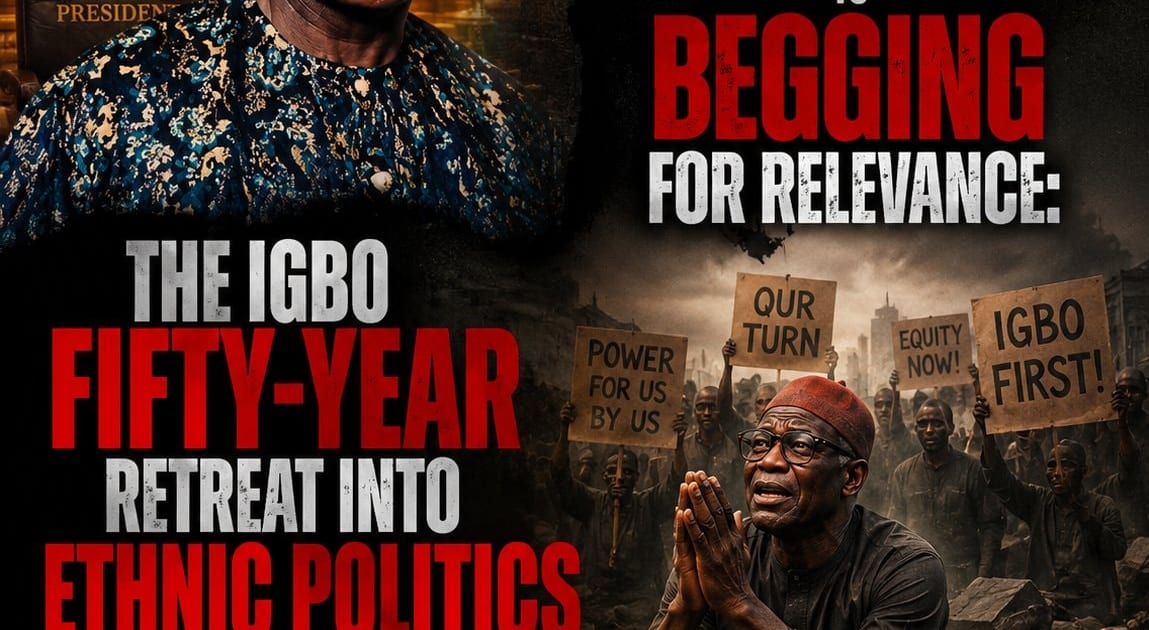
Let us begin with a fact that the Igbo political class would rather you forget. In 1979, Dr. Alex Ekwueme — an Igbo man from Anambra State — was elected Vice President of the Federal Republic of Nigeria. He served four years. He was re-elected in 1983. He sat in Aso Rock, a heartbeat from the highest office in the land, and the country did not collapse. The Yoruba did not riot. The North did not secede. Nigeria simply governed itself, as it does, with an Igbo man in the second seat.
That was 1979. Forty-seven years ago. Since then, a Yoruba man has been president. A Niger Deltan has been president. A Northerner has been president twice. The Yoruba have also produced a vice president. The Niger Delta has produced a vice president. And the Igbo? The Igbo are still on the outside, still demanding their turn, still insisting that Nigeria owes them the presidency — and still, somehow, managing to make themselves the least electable ethnic group in a country they helped build.
How did this happen? How did the group that produced Alex Ekwueme end up here? That is the question this piece intends to answer. And the answer, I am afraid, is not flattering.
The Ekwueme Baseline
Alex Ekwueme was not a protest candidate. He was not a symbol. He was not a movement. He was a politician — a real one, with real alliances, real compromises, and real power. He ran on a ticket with Shehu Shagari, a Northerner, because he understood that Nigerian politics is a coalition business. You do not win by representing your ethnic group. You win by assembling a coalition that is bigger than your ethnic group. Ekwueme understood this. He built bridges. He won.
The lesson of 1979 was not that Nigeria was ready to accept an Igbo leader. The lesson was that an Igbo leader who was willing to do the unglamorous work of coalition-building — who was willing to sit in the second seat, earn trust, and play the long game — could reach the highest levels of Nigerian power. It was a blueprint. It worked.
The Igbo political class looked at that blueprint and decided it was beneath them.
The Decades of Grievance
What followed Ekwueme was not a strategic retreat. It was a slow, self-inflicted collapse into grievance politics. The civil war — which ended in 1970 — became the permanent frame through which every political calculation was made. The Igbo were victims. Nigeria owed them. The presidency was not something to be earned through coalition-building; it was reparations, owed as a matter of historical justice.
This framing is emotionally understandable. The Biafra war was a catastrophe. The "no victor, no vanquished" reconciliation was incomplete. Real injustices were done and never fully addressed. But grievance, however legitimate, is not a political strategy. You cannot guilt a country into electing you president. You cannot shame 200 million people into handing you power. Power in Nigeria, as everywhere, is taken — through alliances, through numbers, through the patient accumulation of political capital.
The Igbo political class chose grievance over strategy. And for fifty years, they have been losing.
The Yoruba Did the Work
Compare the Igbo trajectory with the Yoruba one. The Yoruba also had their grievances. Chief Obafemi Awolowo ran for president and lost. Moshood Abiola won the 1993 election and had it annulled — a wound that still has not fully healed. The Yoruba had every reason to retreat into ethnic grievance politics. Some of them did, briefly.
But the dominant Yoruba political tradition made a different choice. It built structures. It invested in education and produced a professional class that could operate at the national level. It cultivated alliances — with the North, with the Niger Delta, with whoever was necessary. It played the long game. And when Bola Tinubu decided he was going to be president, he did not go to the country and say "the Yoruba deserve the presidency." He went to the North and cut a deal. He went to the Southeast and made promises. He assembled a coalition. He won.
The Yoruba got the presidency not because Nigeria decided to give it to them. They got it because they built the machine that could take it. There is a difference. The Igbo political class has never built that machine.
The Niger Delta Lesson Nobody Talks About
Here is the part that should sting the most. Goodluck Jonathan — a Niger Deltan, from a minority group that is smaller than the Igbo, from a region with less political history than the Southeast — became president of Nigeria in 2010 and was re-elected in 2011. He did it without the Igbo vote being decisive. He did it by building a coalition that included the North, the Southwest, and the Middle Belt.
The Niger Delta, which has spent decades being exploited and marginalised, managed to produce a president before the Igbo did. Let that sit for a moment. A minority group from the creeks of the South-South, with no historical claim to national political dominance, got to Aso Rock before the Igbo — who have been demanding the presidency as a birthright since 1970.
The difference was not population. The difference was not resources. The difference was that Jonathan was willing to be a Nigerian president first and a Niger Deltan second. He did not campaign on ethnic identity. He campaigned on a platform broad enough to attract votes from people who had never heard of Otuoke. The Igbo political class has never produced a candidate willing to make that trade.
The Peter Obi Paradox
Peter Obi was supposed to be different. In 2022, he generated the most genuine political excitement Nigeria had seen in a generation. Young Nigerians — Yoruba, Hausa, Ijaw, Tiv, all of them — wore his colours and marched in his name. For a brief, electric moment, it looked like an Igbo man had finally cracked the code: build a movement that transcends ethnicity, and the presidency becomes possible.
Then the Obidient movement opened its mouth.
What should have been a national coalition became, in the hands of its loudest voices, an Igbo supremacy rally. The online vanguard of the movement spent more time attacking Tinubu's ethnicity and Atiku's religion than making the case for Obi's governance record. Yoruba people who were genuinely considering Obi were told, in explicit terms, that they were traitors to their tribe if they did not support him. The movement that was supposed to transcend ethnicity became the most ethnically aggressive political campaign in recent Nigerian history.
Obi lost. He lost badly in the North. He lost in the Southwest. He won the Southeast — the one region he was always going to win regardless. The movement that was supposed to prove that an Igbo man could build a national coalition proved the opposite: that the Igbo political class, even when handed a genuinely compelling candidate, cannot resist the pull of ethnic politics.
The Hatred That Dare Not Speak Its Name
There is something else that needs to be said plainly, because the Igbo political class will never say it themselves. The Igbo cannot reach the Nigerian presidency without Yoruba support. The arithmetic is simple. The Southeast alone does not have the votes. The Igbo diaspora in Lagos, Ibadan, and Ogun State cannot deliver those states without Yoruba buy-in. Any Igbo presidential candidate who alienates the Yoruba has already lost.
And yet, the dominant tone of Igbo political discourse toward the Yoruba — particularly online, particularly among the Obidient class — is one of contempt. The Yoruba are dismissed as Tinubu's slaves, as people who sold their votes, as a group too tribal to recognise a good candidate. The very people whose support is mathematically necessary for an Igbo presidency are being insulted daily by the people who claim to want that presidency.
This is not a political strategy. It is a self-defeating tantrum. You do not win votes from people you are busy calling fools.
"The Igbo cannot reach the Nigerian presidency without Yoruba support. And yet the dominant tone of Igbo political discourse toward the Yoruba is one of contempt. You do not win votes from people you are busy calling fools."
— Ishola Adebiyi, The Trojan Beast
What Ekwueme Knew That His Successors Forgot
Alex Ekwueme died in 2017 without ever becoming president. He ran in 1999 and lost the PDP primary to Olusegun Obasanjo — a Yoruba man, backed by Northern power brokers. It was a bitter defeat. But Ekwueme handled it with the dignity of a man who understood that Nigerian politics is a long game, not a single throw.
What Ekwueme understood — and what the current generation of Igbo political actors has forgotten — is that the path to Nigerian power runs through other people. It runs through the North, which has the votes. It runs through the Yoruba, who have the structures. It runs through the Niger Delta, which has the oil revenue leverage. An Igbo president will not happen because Nigeria finally decides to be fair. It will happen when an Igbo politician builds the coalition that makes it happen.
That coalition cannot be built from a posture of grievance. It cannot be built by people who spend their political energy cataloguing historical injustices rather than making new alliances. It cannot be built by a movement that treats every non-Igbo Nigerian as either a tool to be used or an enemy to be defeated.
The Verdict
The Igbo were at the vice presidency in 1979. They have been retreating ever since — not because Nigeria pushed them back, but because they chose ethnic grievance over political strategy, chose the comfort of victimhood over the hard work of coalition-building, and chose to hate the Yoruba more than they wanted the presidency.
A Niger Deltan got to Aso Rock before them. A Yoruba man is there now. The North has been there twice. And the Igbo are still outside, still demanding their turn, still blaming everyone else for a situation that is, in large part, of their own making.
The presidency is not owed to anyone. It is built, brick by brick, alliance by alliance, compromise by compromise. Alex Ekwueme knew this. He sat in the second seat and earned his place. His successors decided that was beneath them. Fifty years later, they are still waiting for a seat at the table they refused to build.
Don't miss the next story
Get The Trojan Beast's biggest stories delivered to your inbox.
Found this story important? Share it.
More to Read
More Opinion

About the Author
Ishola Adebiyi
Lead Correspondent, The Trojan Beast
Ishola Adebiyi is the lead correspondent and co-founder of The Trojan Beast. He covers Nigerian politics, power, and accountability with a sharp eye for the stories others miss.