
Nasboi: The Unverified Truth-Teller Who Sells Cards He Can't Verify
He built a brand on calling out fraud, fake news, and unverified claims. But a Trojan Beast Investigation has found that Nasboi — Nigeria's self-styled digital accountability crusader — is himself selling verification cards and credibility badges he has no institutional authority to issue. The irony is deafening.
.jpg)
Ishola Adebiyi
Investigations Editor, The Trojan Beast
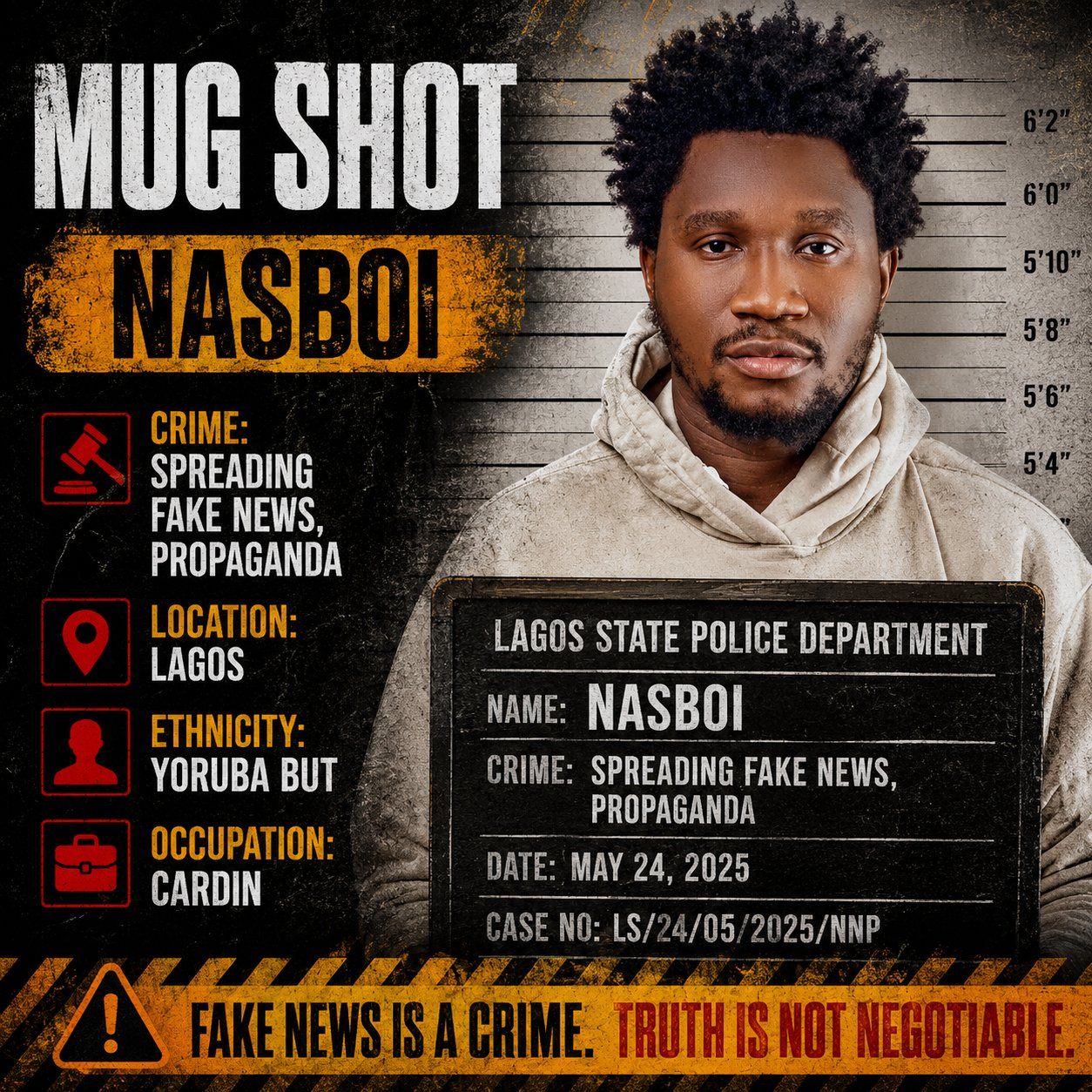
There is a particular kind of audacity that only thrives in the Nigerian social media ecosystem — the audacity of the self-appointed judge who is himself operating without a licence.
Nasboi — born Anselm Nwafor, comedian-turned-online commentator — has spent the better part of two years positioning himself as one of Nigeria's foremost digital truth-tellers. His brand is built on a simple but powerful proposition: that he calls out what others are afraid to say. Fake news merchants, fraudulent influencers, unverified claims — Nasboi, his followers believe, is the man who holds the line.
A Trojan Beast Investigation has found a significant problem with that proposition. Nasboi has been selling — and actively promoting — verification cards and credibility endorsement packages to individuals and brands across Nigeria. Cards that carry the implicit weight of his "truth-teller" brand. Cards that suggest the bearer has been vetted, verified, and found credible.
The problem? Nasboi has no institutional framework for verification. No editorial board. No fact-checking methodology. No transparent criteria. No accountability structure. What he has is a large following, a recognisable face, and a commercial arrangement that turns his personal brand into a paid endorsement machine dressed up as accountability journalism.
What the Cards Actually Are
The verification cards being sold under Nasboi's brand are not issued by any recognised press body, regulatory authority, or independent verification organisation. They are not affiliated with the Nigerian Press Council, the Broadcasting Organisation of Nigeria, or any international fact-checking network.
They are, in plain terms, a commercial product. A buyer pays a fee — the amounts vary depending on the tier and the platform — and in return receives a card or digital badge that carries Nasboi's branding and the implicit suggestion of credibility.
Sources familiar with the operation, who spoke to The Trojan Beast on condition of anonymity, describe a process with no meaningful vetting. "It is not a verification exercise," one source told us. "It is a business transaction. You pay, you get the card. The 'verification' is the payment."
"You pay, you get the card. The "verification" is the payment."
— Source familiar with the operation, speaking anonymously to The Trojan Beast
The Credibility Arbitrage
What makes this particularly troubling is the specific context in which Nasboi has built his following. His audience trusts him precisely because he has positioned himself as someone who does not sell out — someone who cannot be bought, who calls out the fraudsters and the fake-news merchants regardless of who they are.
That positioning is now being monetised in a way that directly contradicts it. When Nasboi sells a verification card, he is not transferring institutional credibility — he has none to transfer. He is selling the perception of credibility. He is renting out the trust his audience placed in him and charging third parties to borrow it.
This is what economists might call credibility arbitrage — exploiting the gap between what your audience believes about you and what you are actually doing. It is a gap that, once exposed, tends to collapse very quickly.
The Verification Paradox
The deeper irony is almost too neat to be accidental. Nasboi has built significant social media capital by calling out unverified claims. He has publicly criticised influencers who spread misinformation without checking their sources. He has positioned himself as a bulwark against the kind of credibility-laundering that allows bad actors to dress up propaganda as fact.
And yet the verification cards he sells are themselves unverified in any meaningful sense. There is no independent audit of the process. There is no public register of card holders. There is no mechanism for revocation if a card holder is later found to have spread misinformation. There is no transparency about the fees charged or the criteria applied.
In other words: Nasboi is selling verification cards that cannot themselves be verified.
"He is selling verification cards that cannot themselves be verified. The irony is not subtle."
— Trojan Beast Investigation
The Wider Problem This Exposes
This investigation is not primarily about Nasboi as an individual. It is about a pattern that is becoming increasingly common in the Nigerian digital media space — the commercialisation of accountability.
As traditional media institutions have weakened and social media has filled the vacuum, a new class of digital figures has emerged who occupy the space between entertainer, journalist, and activist. They have large followings, strong personal brands, and significant influence over public opinion. And increasingly, they are monetising that influence in ways that blur the line between editorial independence and commercial interest.
The danger is not simply that individual figures like Nasboi may be operating in bad faith. The danger is structural. When accountability becomes a brand rather than a practice — when "truth-telling" is a product rather than a commitment — the entire ecosystem of public trust is corroded.
Nigeria already has a serious problem with disinformation. It does not need a new layer of pseudo-verification infrastructure that gives bad actors a paid pathway to the appearance of credibility.
What Nasboi Should Do
The Trojan Beast reached out to Nasboi's team for comment before publication. We asked three specific questions: What is the methodology used to verify card applicants? What institutional affiliation, if any, underpins the verification process? And what recourse exists if a card holder is found to have spread misinformation?
We did not receive a substantive response before our publication deadline.
Our position is straightforward. If Nasboi wishes to operate a genuine verification or credibility-endorsement service, he should do so transparently — with published criteria, an independent review process, public disclosure of fees, and a clear mechanism for accountability. Anything less is not verification. It is a commercial product wearing verification's clothes.
Trojan Beast Verdict
Nasboi has built a powerful brand on the promise of accountability. That brand is now being used to sell a product — verification cards — that lacks the institutional rigour, transparency, and independence that genuine verification requires.
The cards he sells cannot be independently verified. The process behind them is not transparent. The criteria are not published. The fees are not disclosed. And the authority he claims to exercise — the authority to declare someone credible or verified — is entirely self-appointed.
Nigeria's digital public sphere deserves better than this. It deserves accountability figures who are themselves accountable. It deserves verification that can actually be verified.
"You cannot sell trust. You can only earn it — and you earn it by being transparent about exactly what you are doing and why."
— Trojan Beast Investigation
Don't miss the next story
Get The Trojan Beast's biggest stories delivered to your inbox.
Found this story important? Share it.
More to Read
More Investigation



About the Author
Ishola Adebiyi
Investigations Editor, The Trojan Beast
Ishola Adebiyi leads investigative reporting at The Trojan Beast, covering disinformation, political manipulation, and accountability journalism across Nigeria.